SEO for Therapists & Mental Health Professionals (2026)

Looking for SEO services for your therapy practice?
Let’s get one thing straight: SEO for therapists (like any kind of marketing for therapists) should never be about turning mental health care into a sales pitch.
Seriously, ew.
Instead, you want to make your practice easier to find when someone is already searching for support. You also want to help that person quickly understand whether you may be the right fit (so they can book an appointment and start feeling better!)
A thoughtful SEO strategy (and GEO strategy) can help therapists, counselors, psychologists, and other mental health professionals appear in relevant Google searches, communicate their services more clearly, and attract qualified inquiries without relying on fear-based messaging or aggressive marketing tactics.
Here’s what you need to know to make it happen!
What Is SEO for Therapists?
When a potential client searches for phrases such as “anxiety therapist near me,” “couples counseling in Columbus,” or “online trauma therapy in Ohio,” search engines must determine which providers are the most relevant, credible, and useful to show.
SEO helps communicate that information through your website content, service pages, location details, Google Business Profile, reviews, and other trusted online mentions. The goal is not to attract the largest possible audience, but to help the right people discover your practice at the moment they are actively looking for care.
Why SEO Matters for Mental Health Practices
Most people looking for mental health support do not begin with the name of a specific practice. They begin with a need.
They may search for “therapist for anxiety near me,” “marriage counseling in Columbus,” “online trauma therapy in Ohio,” or “therapist accepting new clients.” If your website does not clearly explain what you offer, who you help, and where you provide services, search engines may struggle to connect your practice with those searches.
SEO helps close that gap.
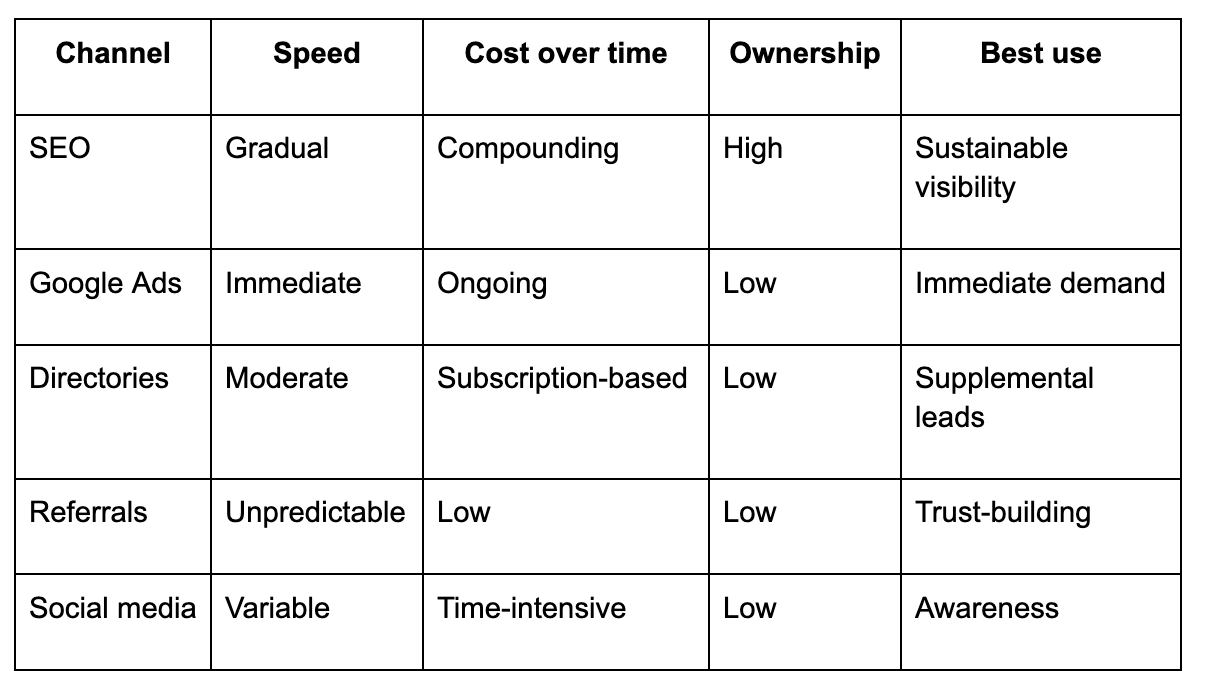
A strong SEO strategy can also reduce your dependence on paid advertisements, social media algorithms, and third-party directories. Platforms such as Psychology Today can be useful sources of visibility, but they place your practice alongside many competing providers and give you limited control over how your services are presented.
Your website is a space you own. It allows you to explain your approach, demonstrate your expertise, answer common questions, and guide potential clients toward the next appropriate step.
And you don’t need thousands of monthly website visitors until you start seeing an impact on your business, either.
Ten inquiries from people seeking your specialties, located within your service area, and able to use your payment options are often more valuable than hundreds of visitors who are unlikely to become clients.
Improving your search visibility can also make mental health care feel more accessible. When important information about your services, availability, fees, insurance, location, and treatment approach is easy to find, potential clients can make informed decisions with less uncertainty.
In that sense, ethical SEO is not only a marketing strategy. It’s also a way to reduce confusion and help people connect with appropriate care.
How to Choose SEO Keywords for a Therapy Practice
Choosing the right keywords begins with understanding the services you offer and the way potential clients describe what they need. Therapists often use professional language that clients may not know, while clients are more likely to search using symptoms, life situations, or practical questions. Your keyword strategy should account for both.
A useful starting formula is:
Service or specialty + client concern + location or logistical qualifier
For example:
Anxiety therapist in Columbus
Couples counseling in Dublin, Ohio
EMDR therapist accepting new clients
Child psychologist who accepts Aetna
Online trauma therapy in Ohio
Grief counselor with evening appointments
These longer, more specific phrases may have lower search volume than broad terms such as “therapy” or “mental health,” but they often reflect stronger intent. Someone searching for “therapy” may still be gathering general information, while someone searching for “trauma therapist accepting new clients in Columbus” is likely much closer to contacting a provider.
Each core page on your website should target one primary keyword or closely related group of phrases. Your homepage may focus on your main service and location, while individual service pages can target specific concerns, treatment approaches, or audiences. This helps search engines understand the purpose of each page and prevents several pages from competing for the same keyword.
For example, a practice might organize its keyword strategy like this:
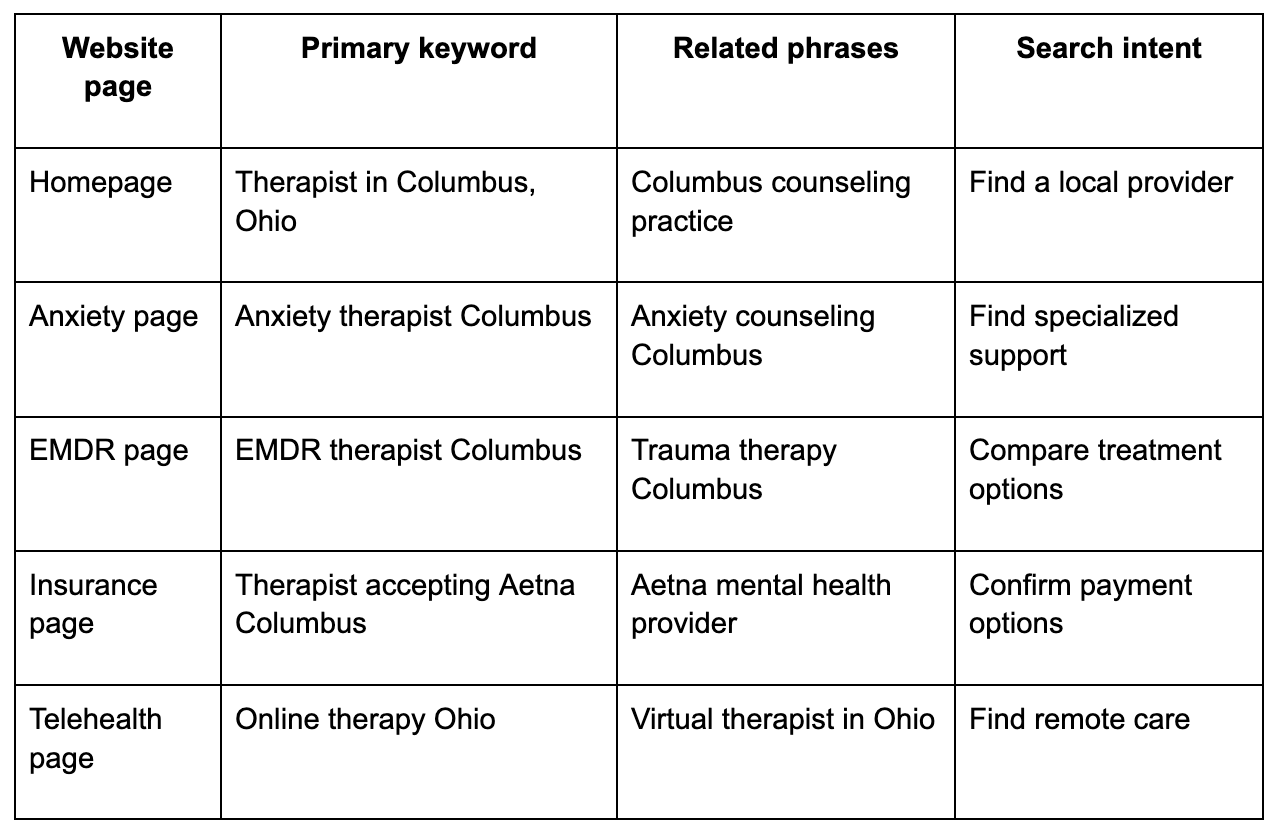
Keyword research tools can help identify variations and estimate how often people search for them, but search volume should not be the only deciding factor. The best keywords are relevant to your actual services, reflect the clients you are qualified to support, and align with the geographic areas you can legally serve.
Pay attention to the language your clients already use. Questions from consultations, intake forms, referral partners, and frequently asked questions can reveal valuable search terms that keyword tools may overlook. The words people use when describing their concerns often provide the clearest roadmap for creating useful, relevant website content.
Build a Dedicated Page for Each Major Service
Many therapy websites list every specialty on one general services page. While this may seem simpler, it can make it harder for both search engines and potential clients to understand the full scope of your work. A dedicated page for each major service gives you more space to explain your expertise, answer relevant questions, and target the specific phrases people use when searching for support.
On-Page SEO for Therapists
On-page SEO refers to the elements you optimize directly on each page of your website. These elements help search engines understand what the page is about while making the content easier for potential clients to read, navigate, and trust.
Every important page should have one clear purpose. A page about anxiety therapy should focus primarily on anxiety therapy, while a page about couples counseling should address the concerns, questions, and search terms associated with couples. Trying to optimize one page for several unrelated services can weaken its relevance and make the content less helpful.
Suppose a therapist wants to rank for the phrase “anxiety therapist in Columbus, Ohio.” The page might be structured like this:
Primary keyword: Anxiety therapist in Columbus, Ohio
SEO title:Anxiety Therapist in Columbus, Ohio | Practice Name
Page heading:Anxiety Therapy in Columbus, Ohio
URL:/anxiety-therapy-columbus-ohio
Meta description:Looking for an anxiety therapist in Columbus, Ohio? Learn about our compassionate approach, appointment availability, insurance options, and how to get started.
Before Publishing Any Page, Use This SEO Checklist
A clear primary keyword and search intent
A descriptive SEO title
One main page heading
A short, readable URL
An introduction that answers the search quickly
Helpful subheadings
Original, service-specific content
Relevant internal links
Accurate image alternative text
Clear location and availability information
A compassionate call to action
A meta description written to encourage qualified clicks
Good on-page SEO should not be noticeable to the reader. The page should simply feel clear, relevant, and easy to use. When the content answers the right questions in the language potential clients understand, search optimization and client experience work together.
Local SEO for Therapists
Local SEO helps your practice appear when someone searches for mental health services in a specific area. These searches may include phrases such as “therapist near me,” “anxiety counselor in Columbus,” or “couples therapist in Dublin, Ohio.” Because many potential clients prefer a provider nearby (or need someone licensed to serve their state) local visibility is one of the most important parts of SEO for therapists.
Google’s local search results are primarily influenced by three factors: relevance, distance, and prominence. Relevance refers to how closely your practice matches what someone is searching for. Distance considers how far your practice is from the person searching. Prominence reflects how established and trusted your business appears online, based partly on factors such as reviews and links from other websites.
Optimize Your Google Business Profile
A Google Business Profile allows your practice to appear in Google Maps and local search results. Complete and accurate profiles are more likely to appear for relevant local searches, so therapists should fill out every applicable field rather than creating a profile and leaving it mostly empty.
Use an Eligible Practice Address
Address eligibility can be complicated for therapists who work from shared offices, rented rooms, virtual offices, or home-based practices. Google requires businesses to represent a real location accurately. Virtual offices are generally not eligible, and an office inside a coworking space must meet requirements such as having clear signage, receiving clients at the location, and being staffed by the business during its stated hours.
Do not use a P.O. box, mailbox service, or rented address where you do not actually practice. An inaccurate address may initially help a profile appear in a desired city, but it can also lead to verification problems or suspension.
Build Consistent Local Listings
Online listings, sometimes called local citations, help reinforce information about your practice. Focus on directories that are reputable, relevant, and likely to be used by potential clients. Listing your practice on hundreds of unrelated or low-quality websites is unlikely to provide meaningful value. A smaller number of accurate, trusted listings is generally more useful than a large number of inconsistent ones.
Professional licensing directories
Psychology Today
Local chambers of commerce
Community resource directories
Professional associations
Insurance-provider directories
Local wellness organizations
Earn Relevant Local Backlinks
Backlinks are links from other websites to yours. They can strengthen local prominence by showing that community organizations, referral partners, and respected publications recognize your practice. Google specifically notes that links from other websites can contribute to how prominent a business appears in local results.
Therapists may be able to earn local backlinks through:
Professional association profiles
Community directories
Guest articles
Podcast interviews
Local news features
University alumni profiles
Chamber memberships
Nonprofit partnerships
Workshops and speaking engagements
Referral relationships with related providers
Sponsorships of relevant community events
Google Reviews and Therapist Ethics
Online reviews can support local SEO and help potential clients evaluate a practice, but therapists must approach them carefully. Unlike most businesses, mental health professionals must consider confidentiality, professional ethics, licensing rules, and the power imbalance within the therapeutic relationship.
Check the rules.
Before requesting reviews, therapists should check the rules established by their licensing board, professional association, employer, and applicable privacy laws. Some professional codes restrict or prohibit soliciting testimonials from current clients or others who may feel pressured to participate.
Don’t pressure clients.
When review requests are permitted, they should always be voluntary, neutral, and free from incentives. Therapists should avoid asking immediately after an emotional session, selectively approaching only satisfied clients, or suggesting that positive feedback is expected. Clients should also understand that posting a public review may reveal their connection to the practice.
Maintain client privacy.
Therapists must never confirm that a reviewer is a client or discuss treatment in a public response. Even when a reviewer shares personal details, the practice should not reference appointments, diagnoses, billing, or private conversations.
A general response might say:
Thank you for sharing your feedback. Because we protect the privacy of everyone who contacts our practice, we cannot discuss individual experiences publicly. Please contact our office directly if you would like to discuss a concern.
Reviews are not the only way to build trust. Detailed provider bios, credentials, professional memberships, educational content, community partnerships, and clear information about services, fees, and availability can all strengthen credibility without asking clients to share sensitive experiences publicly.
Build a More Visible, Trustworthy Mental Health Practice
SEO can help therapists and mental health professionals reach the people who are already searching for support. The strongest strategies combine clear service pages, thoughtful keyword research, local optimization, helpful content, and a trustworthy online presence. More importantly, they make it easier for potential clients to understand your approach and decide whether your practice is the right fit.
Emerald Creative Content helps service-based businesses improve their search visibility through people-first SEO, website content, and local search strategy. Request a free SEO audit to learn how your mental health practice is currently performing, where you may be losing visibility, and which improvements could make the greatest impact!